
NetSuite Next began rolling out with the 2026.2 release in July, starting with the US and Canada. It is not a separate product and it is not a migration. Your data, roles, permissions, workflows and customizations stay exactly where they are, users can move between the two experiences without anything changing underneath them, and Ask Oracle is included in the NetSuite license.
Ask Oracle is what sits at the center of it. Describe what you want in your own words and it queries your data, builds the report, surfaces the insight, navigates to the record, completes the task. The part worth your attention, though, is not in the demo.
Oracle's own FAQ says two things a few paragraphs apart. The first is that NetSuite Next runs on a single, unified data model across finance and operations. The second is that Ask Oracle does not browse the public internet, works inside your NetSuite instance, and operates within your existing roles and permissions, so it cannot see or do anything the person asking could not already see or do.
Both of those are features, and the second is the reason you can trust the first. An assistant that quietly reached around your permissions would be a liability the first time an auditor asked about it. An assistant grounded in one governed data model, with answers that link back to the records underneath them, is the only kind that should be allowed anywhere near a close.
Put together, they also draw a property line, and the line is the edge of your NetSuite instance. Everything inside it is now answerable. Everything outside it is not partly visible or slightly out of date. It is absent.
In most companies running NetSuite, finance is inside. Orders, inventory, fulfillment, receivables, the entire back office is inside, which is the reason you bought NetSuite in the first place. Sales is usually outside, in a separate CRM, joined to everything else by a two-way integration that somebody owns and everybody has opinions about.
So the half of the business carrying all of the narrative is the half the new assistant cannot read. The back office records what happened. Sales records why it happened. Why the deal moved in August and stopped in September, what got promised on a call, which objection came back a third time, who joined the buying group in July and quietly turned out to be the person deciding. That is the interpretive material, the part that explains the numbers, and it is sitting on the wrong side of the line.
The usual answer is that the integration handles it, and at the field level it does. But a sync moves fields, not context. It is lossy by construction, because you can only map what both systems already have in common, which is precisely the structured, tidy, uninteresting part. It lags by whatever the schedule is. It is a maintenance surface that gets exciting twice a year at release time. And because it runs in both directions, "which copy is right" stops being a question anyone answers once and becomes a standing item. You are paying, in money and in somebody's Thursday, to keep two versions of the same customer in approximate agreement.
Set the AI aside for a moment, because most of this was true before Ask Oracle existed. When sales works on the same records finance works on, the quote goes out on the price list, currency and discount rules finance actually set, rather than a price book that was correct in June. The estimate becomes a sales order without anyone rekeying it, because it was a NetSuite record the whole time. The expansion conversation gets planned against real customer history: terms, aging, what is on credit hold, what they have bought before. The whole picture, rather than the optimistic half of it.
And then there is the part almost nobody designs for, which is everything after Closed Won. A relationship does not stop producing information when the deal closes. It starts. Orders ship or they slip. Invoices get paid, late, or not at all. A renewal comes around. Support hears something the account team never does. In a bolted-on CRM the record goes quiet at exactly the moment the customer becomes valuable, and whoever owns the relationship has to go ask someone in finance and wait. On NetSuite the ongoing business is sitting on the same account as the next opportunity, because it never had to travel anywhere to get there.
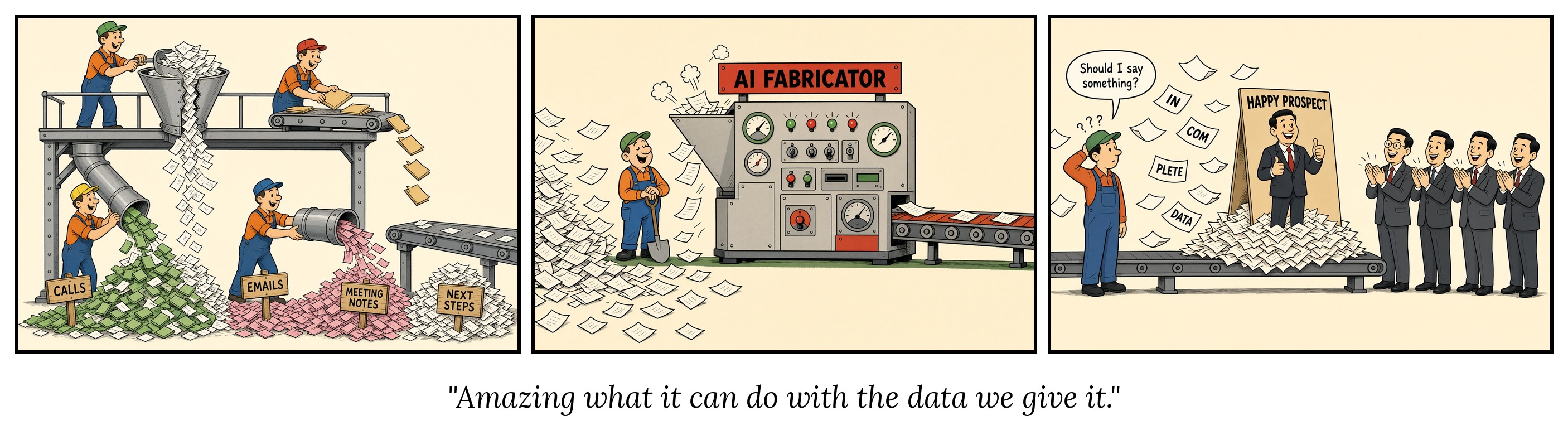
What changes with NetSuite Next is the math on what is worth writing down. A record used to be worth whatever a human could read off it, which put a quiet ceiling on how much detail was worth capturing, because nobody wants to write a paragraph that never gets read. Now a record is also the material an assistant reasons over, for every question anyone in the company thinks to ask. Detail that was nice to have has turned into the thing that decides whether the answer is any good.
Which brings up the honest limit, and it is ours rather than Oracle's. Ask Oracle can query anything in NetSuite. It cannot make a phone call land on a record. It cannot put the reason a deal stalled onto the opportunity if nobody ever wrote the reason down. A unified data model with a thin sales half does not produce an answer that looks thin. It produces a confident, fluent, well-organized paragraph about very little, and that is worse than an obviously poor answer, because an empty subtab announces itself and good prose does not.
That is the order of operations Vendios is built on. It lives on native NetSuite records, so the sales half is inside the property line with no sync to maintain, and the deal, the quote, the order and the invoices are on one account because they always were. Then the AI layer does the part nobody has automated: calls and emails transcribed and summarized onto the deal, so recording what happened is a byproduct of selling instead of a second job that waits until Friday and gets done from memory. Capture first, then the read on top of it. In that order, because the other order does not work.
Oracle is handing every NetSuite customer an assistant that can read everything you give it. Take advantage of that, and give it as much to read as you can. The question worth arguing about this quarter is not whether to turn it on. It is how much of your data it is going to find when you do.
If you want to know where your own account stands:
Curious what your pipeline looks like when the CRM finally works the way sales does?
See Vendios in action